
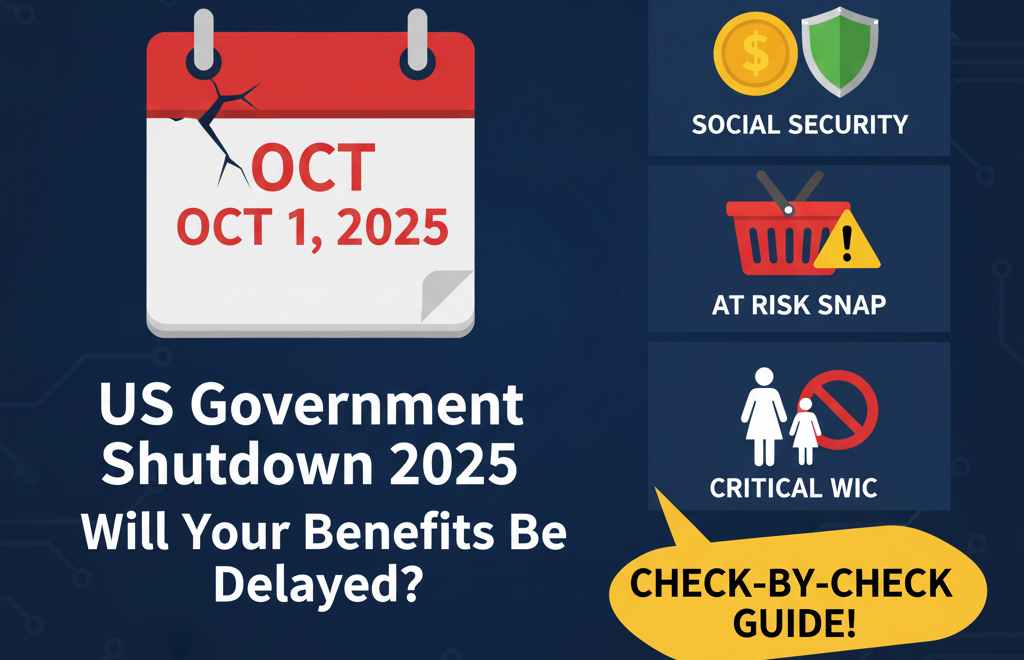

Will Your Social Security, SNAP, or WIC Benefits Be Delayed? (A Check-by-Check : Guide)
Your Critical Financial Questions Answered Amid the Funding Crisis
The calendar has flipped to October 1, 2025, and Congress has, once again, failed to pass the critical spending bills required to fund the federal government. This is not just a Washington D.C. political squabble; for millions of American households and vulnerable families, it’s an immediate, urgent financial threat. The phrase on everyone’s mind is: Will my benefit check arrive on time?
This definitive guide breaks down the immediate impact of the 2025 shutdown on the most vital social programs. We’ll tell you what’s SAFE, what’s AT RISK, and what steps you can take right now to protect your household income.
🛑 The Core Question: Why Are Payments at Risk?
A U.S. government shutdown occurs when funding for discretionary programs lapses. The crucial difference lies between Mandatory Spending and Discretionary Spending:
- Mandatory Spending: This category includes programs like Social Security, Medicare, and certain parts of Medicaid. They are funded by permanent laws (like payroll taxes and trust funds), meaning the money is not subject to the annual Congressional appropriations fight. These payments are generally safe.
- Discretionary Spending: This covers the majority of federal agencies, including funding for services, administration, grants, and programs like WIC. If Congress doesn’t pass a funding bill, these funds immediately freeze, halting non-essential services and creating funding crises for certain essential programs.
The 2025 shutdown is particularly tense due to key political sticking points (such as the extension of Affordable Care Act tax credits), which suggest a potentially protracted and volatile funding standoff.
💰 Social Security and SSI: Your Money is Safe (But Services Slow)
If you are a senior, a person with a disability, or a dependent relying on the Social Security Administration (SSA) for monthly income, you can breathe a sigh of relief on the payment front.
The Current Status (OCT 2025):
| Program | Payment Status | Reason |
| Social Security (Retirement, Disability) | CONTINUES ✅ | Funded by the Social Security Trust Funds (Mandatory Spending). Payments are not dependent on annual appropriations. |
| Supplemental Security Income (SSI) | CONTINUES ✅ | Also considered Mandatory Spending. Checks will arrive on schedule. |
The Critical Risk: Slowdown, Not Stoppage
While your check will arrive, the SSA is forced to furlough non-essential staff. This means if you need administrative help, prepare for major headaches:
- New Applications: Processing for new Social Security and SSI claims will slow significantly, adding weeks or even months of delay for approval.
- Customer Service: Phone lines will be limited, and in-person field offices will likely have reduced staff for everything except the most critical, life-or-death issues.
- Administrative Tasks: Services like issuing replacement Medicare cards, updating or correcting earnings records, or providing benefit verification letters will be paused or heavily delayed.
📌techusnews24.com Action Point: If you have an urgent need for an SSA service, use the online portal at ssa.gov/myaccount/ first. If you haven’t yet applied for benefits, expect the delay and make sure all required documentation is ready now.
🍽️ SNAP (Food Stamps): October Payments Are Secured—But Beware of a Long Shutdown
The Supplemental Nutrition Assistance Program (SNAP) is the largest food assistance program in the U.S., helping millions of families. The funding mechanism here is complex, but the immediate picture is reassuring.
The Current Status (OCT 2025):
- SNAP October Payments: CONTINUES ✅. The U.S. Department of Agriculture (USDA) typically pre-approves and obligates SNAP funding for the following month before a shutdown begins. As such, your October 2025 EBT benefits should be deposited on time.
- State-Level Administration: State SNAP offices continue to process applications and recertifications, but they rely on federal funding for their administrative costs.
The Critical Risk: The Long-Term Threat
The real danger comes if the shutdown extends deep into November 2025 and beyond:
- Depleted Reserve Funds: While the USDA holds a contingency fund, a prolonged shutdown could eventually deplete these resources, putting November and December payments at risk.
- Administrative Breakdown: States depend on federal support for processing and oversight. If a shutdown lasts weeks, furloughs at the federal level could hinder the essential financial transfers and technical guidance necessary for states to operate.
📌 techusnews24.com Action Point: If you have savings, treat your October SNAP benefit as a resource you may need to stretch further than usual. Ensure your recertification documents are submitted immediately, as delays in application processing could cause a gap in future benefits.
👶 WIC: The Most Vulnerable Program Right Now
The Special Supplemental Nutrition Program for Women, Infants, and Children (WIC) is one of the programs most immediately threatened by a shutdown because it relies entirely on Discretionary Spending and is funded annually.
The Current Status (OCT 2025):
- WIC Payments/Vouchers: AT RISK ⚠️. The timing of this shutdown, right at the start of the Fiscal Year (Oct 1), is the worst possible scenario. States have limited funds on hand.
- The Funding Lifeline: The National WIC Association emphasizes that while the program has a small contingency fund and states can use up to 3% of last year’s carryover funds, this money can only sustain the program for a short period—likely one to two weeks.
- New Applicants: Services for new applicants may be the first to be suspended in many states to conserve funds for current participants.
The Critical Risk: State-by-State Disruption
WIC stability will vary by state. Some states may choose to use their own general funds to keep the program operational temporarily, hoping for later reimbursement from the federal government, while others may be forced to:
- Halt all services to new applicants.
- Put current participants on a waiting list if the shutdown lasts more than a couple of weeks.
📌 techusnews24.com Action Point: Do not assume your WIC center is open. Check your state WIC agency website or app immediately for local operational updates. Continue to use your benefits and attend appointments until your local agency explicitly states otherwise.
🛡️ Other Essential Services: The Financial Freeze
Beyond the “Big Three” benefits, the shutdown casts a long shadow over other critical financial and lifestyle services.
Veterans’ Benefits (VA)
- Payments (Pensions, Disability Compensation): CONTINUE ✅. These are mandatory spending programs and will not stop.
- Services: Routine services at VA hospitals and clinics are expected to continue. However, non-critical services like job training, claims processing, and outreach may be delayed or curtailed due to furloughs of civilian staff.
Housing Assistance (HUD)
- Rental Assistance: Funding for Section 8 vouchers and other HUD programs may be handled through carryover funds, meaning payments will likely continue for a short period.
- Critical Risk: New loans, development, and refinancing of properties requiring Federal Housing Administration (FHA) approval will stop or face major delays.
Tax Refunds and IRS Services
- Current Shutdown Impact: Tax season doesn’t start until the new year, so current tax processing is safe.
- Critical Risk: If the shutdown persists into the winter, it could significantly impact the 2026 tax filing season, potentially leading to delays in tax refunds—a critical financial lifeline for millions of Americans.
✅ Your Financial Action Plan for the 2025 Shutdown
The political gridlock is outside of your control, but your personal financial preparedness is not. Use this checklist to safeguard your household funds:
- Monitor Official Sources ONLY: Do not trust rumors on social media. Follow the official websites for the Social Security Administration (SSA), the USDA (for SNAP/WIC), and your local state agencies for the most accurate, real-time status updates.
- Confirm WIC Status: This is the most urgent program. Call your local WIC clinic or check your state’s official website today for their specific plan of action.
- Create a “Delay” Budget: If you are a federal employee, contractor, or rely on a program at high risk (like WIC or SBA loans), immediately assess your emergency fund. Can you cover 2-4 weeks of expenses without this income?
- Explore Local Aid: If a program is cut, immediately search for local and non-profit food banks, religious organizations, and community action agencies. These groups often step up to fill the gaps during federal crises.
The 2025 Government Shutdown highlights an unavoidable truth: Financial stability relies on a combination of federal support and personal resilience. While your mandatory benefits remain secure, the disruption to services and discretionary programs is a stark reminder to maintain an emergency fund—your ultimate defense against political uncertainty.
Stay informed, stay prepared, and we will continue to update this guide as the situation unfolds in Washington.
TECHUSNEWS24.COM


